
Expected Goals (xG) in Handball: The Missing Metric
Handball is a fast-paced, high-volume sport defined by fine margins. However, we continue to analyze it the same way we did 20 years ago: “5 goals from 8 attempts.” But were they easy shots? Were they forced situations?
This is where xG (Expected Goals) comes in—a metric that transforms intuition into science.
From Intuition to Revolution: A Brief History of xG
The concept of Expected Goals wasn’t born yesterday. Although its statistical roots trace back to the 1950s with pioneer analysts like Charles Reep , the modern version we know today exploded in soccer around 2012-2013 .
Analysts like Sam Green (Opta) began to demonstrate that simply counting shots was insufficient; one had to measure the quality of those shots. What started in niche blogs ended up transforming the Premier League and the Champions League. Today, no elite football club signs a striker without looking at their xG.
The Handball Desert
While soccer, basketball (with Moreyball ), and baseball were experiencing their data revolutions, handball was left behind. Why?
- Complexity: Handball is much more fluid than sports like baseball.
- Scarcity of Data: Until recently, there was no culture of recording detailed eventing (shot coordinates, type of defense).
However, recent studies such as those by Mortelier et al. (2023) have shown that highly accurate predictive models can be built using simply the position of the shot , without the need for extremely expensive tracking technologies. This scientifically validates that accessible tools like Eventum can offer professional-level data.
“Advanced analytics is no longer a competitive advantage; it is a requirement to avoid falling behind.”
The Eventum Proposal: Precision and Context
At Eventum , we haven’t just adapted xG to handball; we have rebuilt it with the reality of the court in mind.
To calculate the probability of a goal (0 to 1) for each action, our algorithm crosses critical variables:
- Shot Type: We drastically differentiate between a breakthrough (penetration), an outside shot, a pivot shot, or a first-wave counterattack.
- Court Geometry: Location is king. As science shows, probability varies enormously depending on the zone.
Visualizing Probability
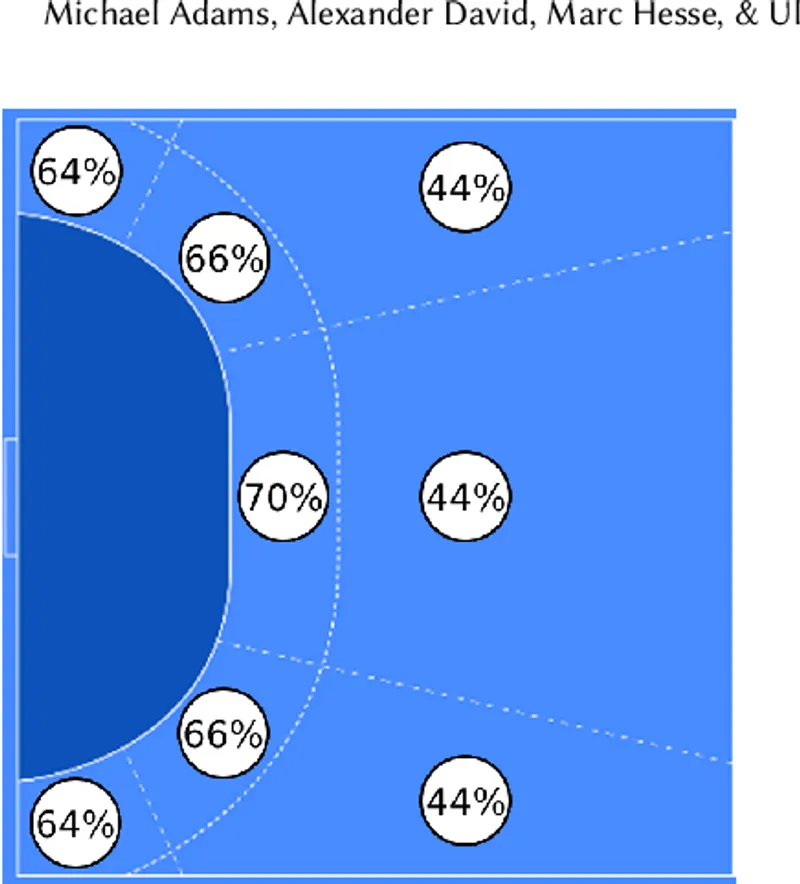
Observe how shot efficiency changes according to position on the court. Data shows that central zones are statistical “gold mines,” while tight angles drastically reduce expectation.
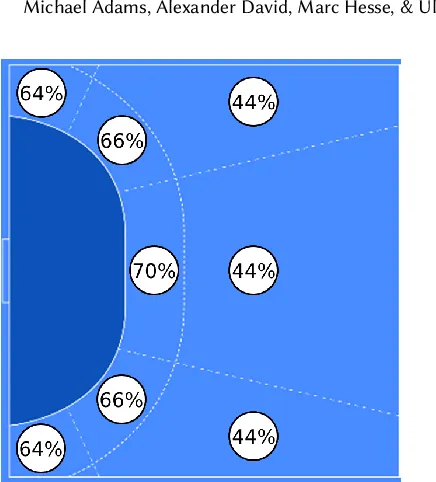
Figure: Example of success probability distribution according to the shooting zone (Source: Adams et al.). Notice how the probability drops from 70% in the central 6m zone to 44% for distant lateral shots.
Our model penalizes closed angles from the wings and rewards central zones based on historical data from thousands of shots. For example, shot density studies confirm that while there are many shots from 9m, efficiency skyrockets when stepping onto the 6m line, where the attacker often faces the goalkeeper without direct defensive interference.
Inspiration and Science: The Anselmo Ruiz Method
Our model is not a black box. The database and calculation methodology are heavily inspired by the research and analysis work of Anselmo Ruiz (@anselmoraq). His approach validates that the context of the shot (opposition, speed, angle) is a determining factor for long-term success.
Your Team, Your Model
We know that handball isn’t just pure mathematics; it’s context. That’s why Eventum democratizes analysis by offering what no one else does: Total Flexibility .
- Default Model: Use our standard algorithm, calibrated with thousands of data points to offer you immediate precision.
- Custom Model: Is your league different? Do you believe the xG from the right wing is lower in youth categories? Eventum allows every user to customize the xG values , creating a model that adapts to your tactical vision.
References for Further Reading
If you want to read more about the science behind goal probability, we recommend searching for:
- Mortelier, A., Rioult, F., & Komar, J. (2023). “What data should be collected for a good handball Expected Goal model?”.
- Adams, M. et al. (2023). “Expected Goals Prediction in Professional Handball using Synchronized Event and Positional Data”.
- Gómez, M.A. et al. (2014). “Performance analysis of elite handball teams”.
Eventum is the tool that bridges data science with the coach’s whiteboard.